
Wobble Boards for Horses: What They Are and How They Work
November 3, 2026
Winter Exercise Ideas for Horses When the Arena Is Frozen
November 3, 2026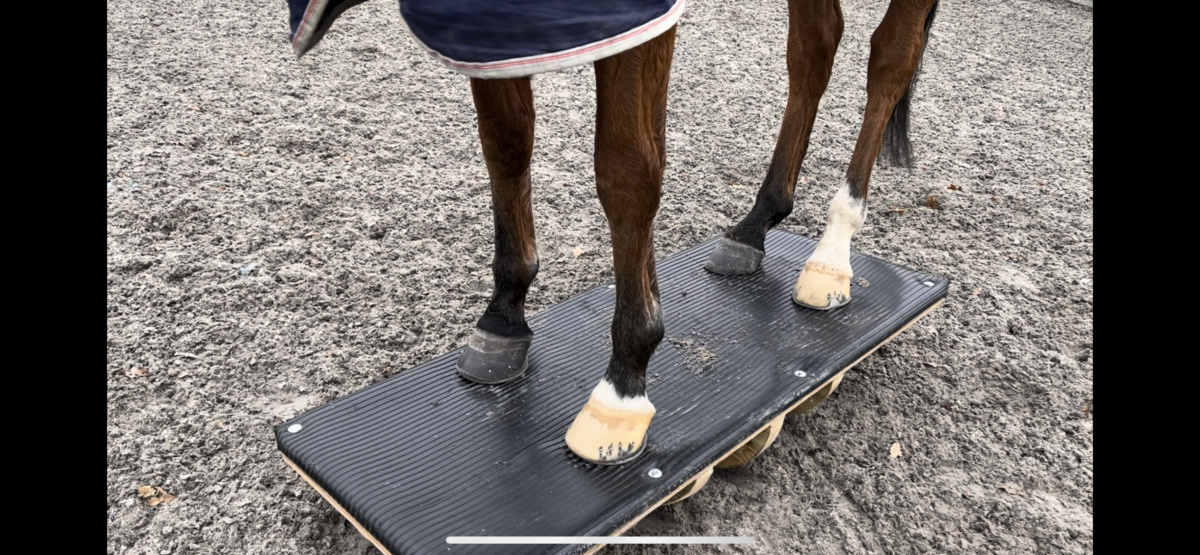
Unridden exercises are one of the simplest ways to build your horse’s core strength and balance. You don’t need a big arena or hours of time: a few minutes of the right groundwork, a few times a week, can make a real difference to how your horse carries itself.
Here are the balance and core exercises we use most with our own horses, from the easiest to the most demanding. If your horse is recovering from an injury, please check with your vet or physio before starting any new exercise.
Why work on core strength and balance?
A horse’s deep core muscles help stabilise the spine and pelvis. A horse with good core strength and balance tends to find it easier to carry a rider, work in a better posture and stay coordinated. Balance work also trains proprioception: the horse’s sense of where its body and legs are.
1. Carrot stretches
Using a treat, ask your horse to bring its nose round to its girth, between its front legs, and down towards its chest. Hold each stretch for a few seconds. These encourage your horse to lift and flex through the back and engage the abdominal muscles. Go slowly and let your horse stretch only as far as is comfortable.
2. Backing up
Asking your horse to step backwards slowly and straight, a few strides at a time, encourages it to engage its hindquarters and abdominals. Quality matters more than distance: aim for calm, even steps.
3. Pole work in hand
Walking your horse over raised or spaced poles makes it think about where it puts its feet and lift through the back. Start with poles on the ground and only raise them once your horse is confident.
4. Standing square and weight shifts
Teaching your horse to stand square, then gently encouraging it to shift its weight forwards and back, is a good introduction to balance work. It’s also the foundation for wobble board training.
5. Wobble board work
A wobble board takes balance work a step further. When the board moves, your horse has to make constant small corrections to stay steady, which engages the deep stabilising muscles without high impact.
- Start with two legs at a time on the Small board, or all four on the One-directional board.
- Begin with 3–5 minutes at a time and build up gradually.
- We do two 10-minute sessions, 2–3 times a week, before riding or lunging.
Our step-by-step guide shows how to introduce a board patiently and safely.
6. Progressing the challenge
Once your horse is confident, you can make balance work harder: add the Frame for more movement, move up to the Bi-directional board for side-to-side work, or try the Circular board for experienced horses.
A simple weekly plan
- 2–3 times a week: 10 minutes of stretches and backing up, then 10 minutes on the wobble board before your main session.
- Once or twice a week: pole work in hand.
- Every session: stop while your horse is still keen, and reward generously.
Get the free 4-session plan
A printable, session-by-session plan for teaching your horse to use a wobble board, with a checklist for each session and a 6-week build-up. Pop in your email and it’s yours.
Add balance work to your routine
Wobbly Horse boards are handmade to order in Hungerford, West Berkshire, with free UK delivery on every board.